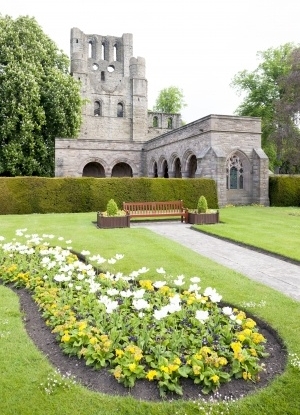
The Scottish Borders is home to four very famous Abbeys. At Melrose Abbey you can visit the Chapter House where the heart of King Robert the Bruce is thought to be buried. Kelso Abbey was apparently subjected to sustained cannon fire by Henry V111’s army during the Rough Wooing of the 1540s. Dryburgh Abbey is near the River Tweed and is an fine example of Gothic architecture. Jedburgh Abbey has a lovely herb garden.
Melrose Abbey
This abbey is a magnificent ruin with lavishly decorated masonry. The abbey was founded by David 1 in 1136 for the Cistercian Order but was largely destroyed by Richard 11’s army in 1385. The exterior is decorated by unusual sculptures, including hobgoblins, cooks with ladles and a bagpipe playing pig! The town of Melrose itself is well worth a visit with lots of places to eat, interesting shops, etc.
Kelso Abbey
Kelso Abbey dates back to the 12th Century, being built in 1128 and the years following, and is one of the finest examples of Romanesque architecture. The wealth of the abbey came from its vast lands, its churches, schools, and farms in the Cheviot Hills. Kelso is a lovely town to visit with shops, restaurants, cafes, garden centres, and lots of walks along the river. Also there is the beautiful Floors Castle with it’s own Garden Centre and Cafes.
Dryburgh Abbey
Dryburgh Abbey has the reputation for being the most beautiful of all the Border Abbeys and the ruins are remarkable complete and surrounded by stunning grounds. It was first established in 1150 and became the premier house in Scotland of the Premonstratensian order and still continues with a peaceful atmosphere.
The graceful ruins became the burial place of David Eskrine, the 11th Earl of Buchan in 1829, and three years later his friend Sir Walter Scott was buried at Dryburgh Abbey too. Despite having been set on fire three times, the Chapter House features paintwork that dates back to 1150 and has some of the best Gothic architecture in Scotland.
Jedburgh Abbey
This abbey was founded by David 1 in around 1138 for Augustinian canons. The church was built in the Romanesque and early Gothic styles and is remarkably complete. Being close to the English Border, Jedburgh Abbey was frequently targeted by invading armies. Remains of the cloister buildings have been uncovered and finds from the excavations, incuding the 12th Century ‘Jedburgh Comb’ and an 8th century shrine are on display.
Close by is the Mary Queen of Scots Visitor Centre and the Jedburgh Castle Jail and Museum.